3K+ happy customers
Unlimited contact with doctors
100% online
Fast and discreet delivery
Dutch partner pharmacy

What is Dihydrotestosterone (DHT)? DHT and hair loss explained
What is DHT and why does it play such a major role in hair loss? In this article, we explain what dihydrotestosterone (DHT) is, how it causes hair loss and what you can do to limit its effects.

If you've recently noticed more hair loss than usual, or are starting to see coves, or discover a bald spot on the back of your head in a photo, it's easy to worry about whether you're going to go bald.
Is it stress? A bad diet? Or is it just bad luck in the genetic lottery after all?
The harsh reality is that hair loss in men is mainly caused by a combination of genetic factors and a hormone called dihydrotestosterone (DHT).
DHT can seem complicated, but it's fairly easy to understand how DHT causes hair loss once you have a basic knowledge of how your body produces DHT, as well as the harmful effects that DHT can have on your hair follicles.
Below, we've explained what DHT is, how it's produced by your body, and the effects it can have on your hair growth. In addition, we'll discuss how you can lower DHT levels so that your hair loss is stopped, or how this can stimulate new hair growth.
What is DHT?
DHT, short for dihydrotestosterone, is a hormone in your body that is produced from testosterone, the well-known male hormone.
This hormone plays a major role in making male characteristics. Not only does it provide things like a deeper voice and a firm bone structure, but also your sexual health.
Even before you're born, DHT starts its work by helping shape male body parts such as the penis and scrotum. During the teenage years, this hormone triggers a growth spurt for your beard, body and pubic hair.
DHT is therefore crucial for developing masculine traits and ensures that boys develop into men. This hormone is one of the building blocks that ensure that men get their physical and sexual characteristics.
What does DHT do?
DHT is produced from testosterone. This occurs through the action of a specific enzyme, 5-alpha reductase (5AR), which converts a small portion of testosterone into DHT. This process takes place in various parts of the body, such as your skin, liver, and prostate gland.
This process also happens in your scalp, where the enzyme converts testosterone into DHT and binds to hair follicles.
Although men typically have much more testosterone than DHT in their system, DHT still has a noticeable influence because of its powerful effect. The normal level of DHT in the blood is approximately one tenth of the testosterone level.
Even in this small amount, DHT can have a major impact on your body. For example, in adults, it can attach to the prostate, causing it to enlarge. This is called benign prostate enlargement, or BPH, and is common in middle-aged men.
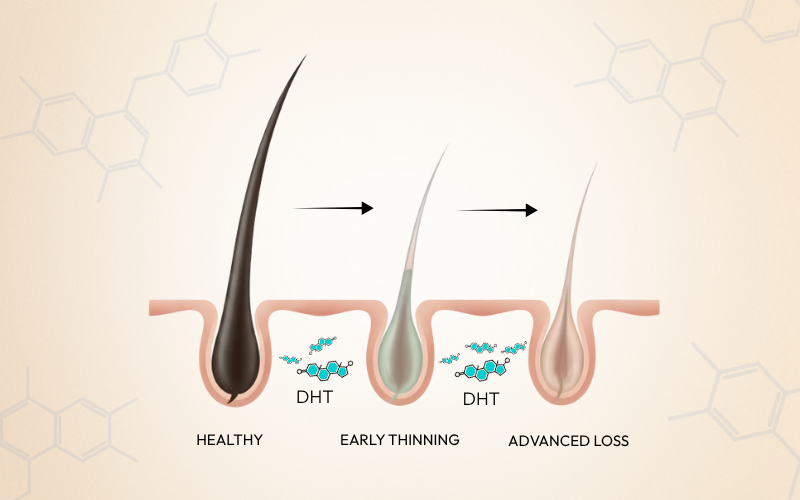
Perhaps the best-known effect of DHT, and probably the reason you're reading this blog, is how it affects your hair. DHT can bind to your hair follicles on your head and stop them from making new hair. This leads to coves, a balding crown and, depending on how sensitive you are to DHT, to almost complete baldness. It is never possible to say exactly how far it will progress for you over time. It depends on how sensitive you are to DHT, not so much on the amount of DHT in your body.
The best predictor is watching your mother's father to see how far your baldness will go, but this offers no certainty either.

DHT and hair loss
In 95% of cases where men go bald, DHT is the culprit. This is because it makes the hair follicles, especially around the hairline and on top of the head, smaller.
This process is actually quite simple. Each hair on your head grows in a multi-phase cycle, often called the hair growth cycle.
In the initial phase, the anagen phase, the hair grows to its maximum length. When this growth period ends, the catagen and telogen phases follow, in which the hair stops growing and is eventually replaced by new hair.
Thanks to this continuous process, you can maintain a full head of hair, even if you lose around 100 hairs a day. As soon as an 'old' hair falls out, a new one is already ready to grow through the scalp.
But when DHT makes the hair follicles smaller, the growth phase becomes shorter and shorter, leading to balding or baldness.
Over time, hair becomes thinner and shorter due to the influence of DHT, until they eventually stop growing through the skin.
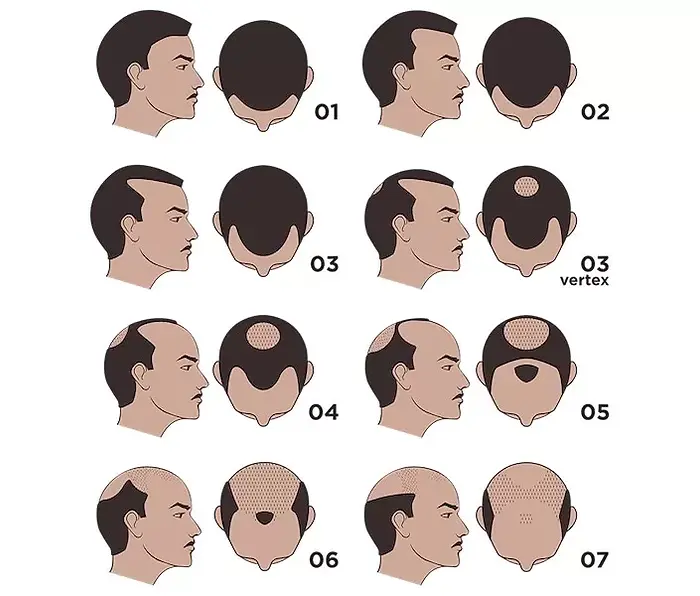
This process starts at the hairline and crown and leads to the typical signs of male hair loss: inlets and a bald spot on the crown. You know it.
Why does DHT cause me hair loss? ? But not with someone else?
Your genes determine a lot, such as your height and hair color, but also how sensitive you are to hair loss.
The term “androgenetic alopecia” refers to male hereditary baldness and combines the words for “androgen” (hormone) and “genetic.”
Some men have hair follicles that are more sensitive to DHT. These bags shrink faster and stop producing new hair sooner if DHT binds to the scalp. If you suffer from hair loss at an early age, you are often more sensitive to DHT, but your body also converts testosterone into DHT more quickly, especially at the hair follicles.
Women also produce some testosterone and thus DHT. Much less than a man but still some amount. Because DHT can already have a small impact on your body in a small amount, women can therefore also suffer from male hereditary baldness.
DHT and Testosterone
DHT and testosterone are both hormones. However, their functions within your body are different.
For a man, testosterone is a very important hormone for general well-being throughout life. This is because testosterone helps maintain normal libido, muscle mass and bone health.
Testosterone is also important for maintaining optimal mental functions, red blood cell production, and energy levels.
As a man, you need testosterone throughout your life, from childhood and adolescence to adulthood.
DHT, on the other hand, is important during childhood and puberty, but it doesn't play a major role in your development as an adult.
As an adult, DHT does not appear to be involved in mental functions, bone health, or the ability to produce muscle mass.
Instead, the main effects of DHT in adulthood include enlarging the prostate and, unfortunately, causing hair loss.
Lowering DHT and stopping hair loss
DHT is the hormone responsible for hair loss in men. So the only way to stop hair loss is to block DHT. Currently, the most effective way to block DHT is with Finasteride.
Finasteride
Finasteride is a drug that has been approved by the FDA to treat male pattern baldness. It works by inhibiting the enzyme 5-alpha reductase, which is responsible for converting testosterone to DHT. By blocking this process, finasteride reduces the amount of DHT in the body.
Clinical studies show that a daily dose of 1 mg finasteride can reduce DHT levels by 70%. This reduction is sufficient for most men to slow down, stop or even reverse hair loss. A lower amount of DHT means that the hair follicles are no longer damaged, allowing hair to grow undisturbed again.
The use of finasteride is relatively easy, as it is available in pill form that should be taken once a day. This makes finasteride an effective and user-friendly option for men who want to combat hair loss. For more information about Finasteride and how it works exactly against hair loss, read the blog: 'Finasteride against hair loss'.
What are the side effects of a DHT blocker?
A small percentage of men who use DHT blockers such as finasteride experience side effects. These can range from a slight increase in testosterone levels to sexual side effects such as erectile dysfunction and decreased libido.
Possible side effects of finasteride include:
- Higher testosterone levels. Finasteride blocks the conversion of testosterone into DHT. This may contribute to a slight increase in total testosterone levels. In a study published in the journal Urology in 2003, researchers found that long-term use of finasteride was associated with a small increase in testosterone.
- Lower libido. Generally, finasteride has no positive or negative effect on libido. However, in a small number of men, finasteride can lead to decreased libido.
- Weak erections. Like decreased libido, this side effect occurs in a small number of men. For example, some men report fewer “morning erections” while taking finasteride, possibly due to lower levels of DHT.
While the aforementioned side effects may seem daunting, the reality is that the vast majority of men taking DHT blockers such as finasteride do not experience any serious side effects.
It's also important to note that, in the rare event that sexual side effects occur, they almost always stop as soon as you stop taking finasteride. It is very unusual for negative effects to persist if you do not actively use a DHT blocker. For a more comprehensive overview of the possible side effects and prevalence, please refer to our blog”What are the side effects of Finasteride?'.
The conclusion about DHT and hair loss
DHT plays an important role in male pattern baldness. It is the hormone that causes coves, a balding crown and thinning your hair. Very annoying, but true. This is also the reason that all other products, such as caffeine shampoo, oils, biotin or Viviscal, won't stop your baldness. Because these products don't block your DHT, and yes, your DHT, that's why you go bald.
If you find yourself going bald, lowering your DHT is the only way to slow down, stop, or reverse this process. Unfortunately, Finasteride has a small chance of side effects, but we believe you're better informed about choosing something that really works than spending endless amounts of money on products that don't really do anything.
If you're ready to take the step to start using Finasteride, you can start the online consultation for free below. If you are looking for more information about Finasteride, please read on our knowledgebase.
Resources
- Kinter, K.J. & Anekar, A.A. (2022, March 9). Biochemistry, Dihydrotestosterone. StatPearls. Retrieved from https://www.ncbi.nlm.nih.gov/books/NBK557634/
- Hoover, E., Alhajj, M. & Flores, J. L. (2022, July 25). Physiology, Hair. StatPearls. Retrieved from https://www.ncbi.nlm.nih.gov/books/NBK499948/
- Ho, C.H., Sood, T. & Zito, P.M. (2022, October 16). Androgenetic Alopecia. StatPearls. Retrieved from https://www.ncbi.nlm.nih.gov/books/NBK430924/
- Could you have low testosterone? (2021, May 13). Retrieved from https://medlineplus.gov/ency/patientinstructions/000722.htm
- Zito, P.M., Bistas, K.G. & Syed, K. (2022, August 25). Finasteride. StatPearls. Retrieved from https://www.ncbi.nlm.nih.gov/books/NBK513329/
- Roerborn, C. G., et al. (2003, November). Effects of finasteride on serum testosterone and body mass index in men with benign prostatic hyperplasia. 62 (5), 894-899. Retrieved from https://pubmed.ncbi.nlm.nih.gov/14624915/
- Finasteride tablet, film coated, FDA label. (2021, June). Retrieved from https://www.accessdata.fda.gov/spl/data/3c8dff7e-41ab-46db-bacf-c41cc237f9d9/3c8dff7e-41ab-46db-bacf-c41cc237f9d9.xml
- Sato, A. & Takeda, A. (2012, January). Evaluation of efficacy and safety of finasteride 1 mg in 3177 Japanese men with androgenetic alopecia. The Journal of Dermatology. 39 (1), 27-32. Retrieved from https://pubmed.ncbi.nlm.nih.gov/21980923/
- Mysore, V. (2012). Finasteride and sexual side effects. Indian Dermatology Online Journal. 3 (1), 62-65. Retrieved from https://www.ncbi.nlm.nih.gov/pmc/articles/PMC3481923/
- 5-alpha reductase deficiency. (2017, April 1). Retrieved from https://medlineplus.gov/genetics/condition/5-alpha-reductase-deficiency/