3K+ happy customers
Unlimited contact with doctors
100% online
Fast and discreet delivery
Dutch partner pharmacy

Finasteride against hair loss
Not sure if finasteride is for you? In this article, you can read how finasteride works against hair loss, what the science says about its effectiveness and what side effects are possible, so you can make an informed decision.

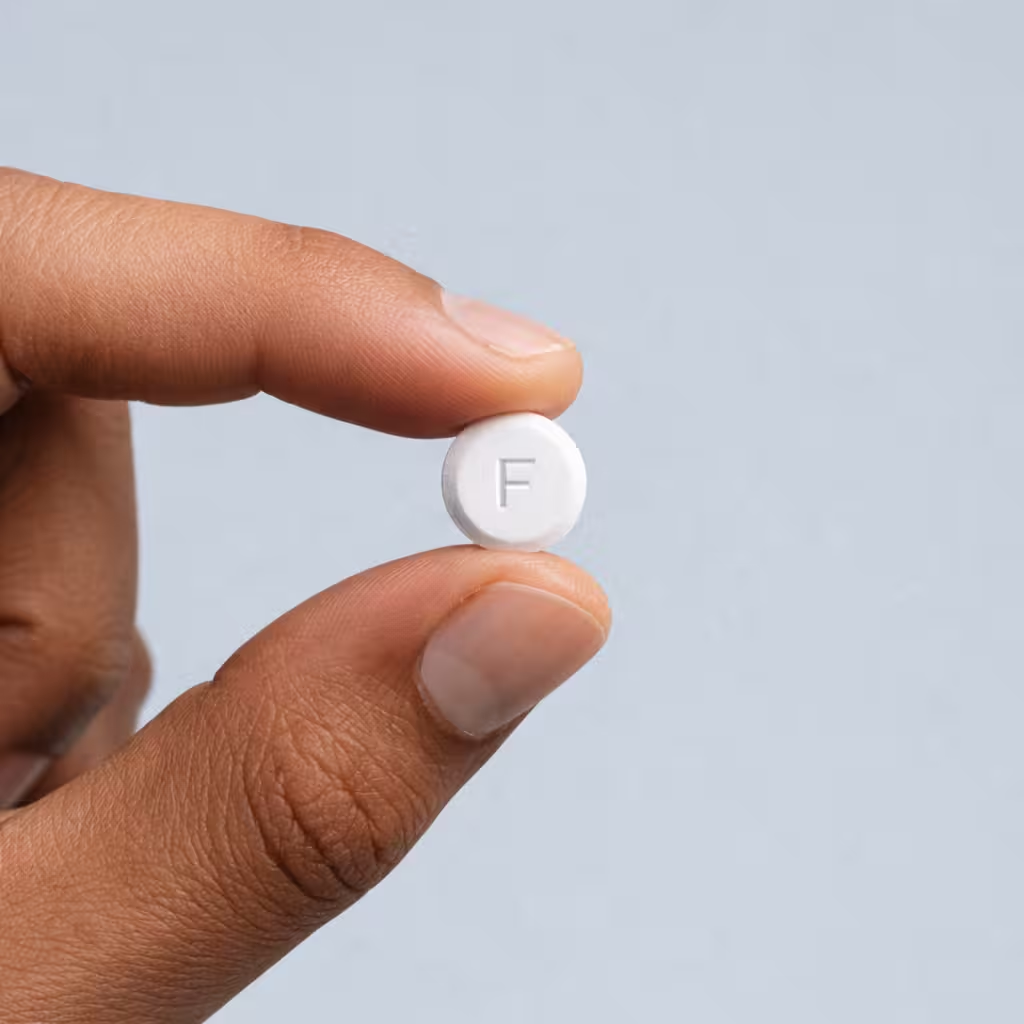
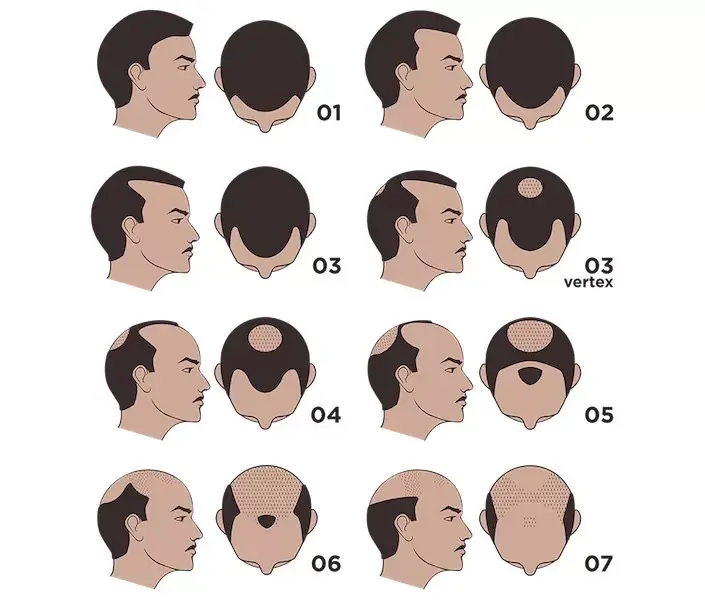
You've noticed it for a while, but lately you're becoming more and more aware of it: your hair is getting thinner. Whether it's a receding hairline, a balding crown, or thinning hair all over your head; hair loss is, to say the least, annoying. If you're not sure if you have male baldness, read our blog about ways to find out if you're going bald.
For a man, his hair is often more than just a physical feature; it's part of his identity, and his hair style reflects his personality. However, the fact that your hair is getting thinner does not mean that you have no options other than taking the clipper.
Hair loss due to androgenetic alopecia, or male hereditary baldness, is treatable in most cases. By acting on time, you can not only prevent further hair loss, but in some cases even get the lost hair back.
Finasteride is known as one of the most effective hair loss medications for men. Finasteride lowers the amount of dihydrotestosterone (DHT) in the body, a substance that plays a crucial role in male baldness.
In the following paragraphs, we'll delve deeper into what exactly Finasteride is and how it helps to reduce, stop, and even reverse the symptoms of male pattern baldness.
We'll also discuss everything you need to know before starting Finasteride, including possible side effects and dosages.
What is Finasteride?
Finasteride is a prescription medication that was approved by the FDA as early as 1996 for the treatment of androgenetic alopecia, or male hereditary baldness.
Initially, finasteride was approved by the FDA as a medication for prostate hyperplasia, or prostate enlargement, under the brand name Proscar®.
A few years later, Finasteride was also approved for the treatment of male hair loss and came on the market under a separate brand name.
Today, both versions of Finasteride — the higher dose for treating an enlarged prostate and the lower dose for hair loss — are available as generic medicines. A generic medicine offers the same effect and quality as the brand-name medicine, but does not carry the brand name. However, it undergoes the same stringent quality controls as the original brand-name drug.
Finasteride is available in tablet form and for best results, you should take one pill daily. The dose of Finasteride for the treatment of male pattern baldness is generally 1 mg per day.
How does Finasteride work against hair loss?
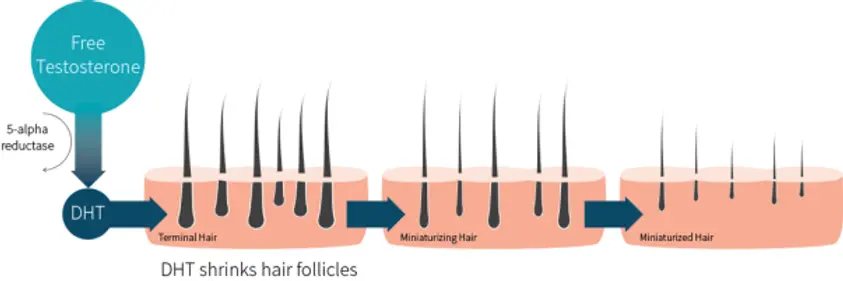
Finasteride belongs to a class of medications called 5-alpha reductase inhibitors. It works by inhibiting the activity of the enzyme 5-alpha reductase. This enzyme is responsible for converting testosterone into dihydrotestosterone (DHT).
DHT plays a crucial role in the process of male baldness. If you are genetically sensitive to DHT, the DHT can bind to your hair follicles, causing them to shrink. This leads to the gradual hair loss that characterizes coves, a balding crown, and thinning hair all over the head. Remarkably, in 95% of cases of male baldness, DHT (and thus male hereditary baldness) is the culprit.
By blocking the action of 5-alpha reductase, Finasteride reduces the amount of DHT in the bloodstream by approximately 70%. This protects the hair from the harmful effects of DHT. A 70% reduction in DHT can result in a delay or even a complete stop of hair loss. Some users of Finasteride even notice that their hair grows back thicker or that hair starts to grow again in previously bald areas on the crown. If you want to know more about why men go bald, read our blog: why do men go bald.
The effectiveness of Finasteride against male pattern baldness is supported by scientific research. A long-term, placebo-controlled clinical trial published in the Journal of Investigative Dermatology Symposium Proceedings found that 90% of men who used Finasteride stopped or significantly reduced hair loss.
What types of hair loss does Finasteride work against?
It's completely normal to lose hair on a daily basis. Most men lose between 50 and 100 hairs each day, without necessarily indicative of male hereditary baldness. This “normal” hair loss is part of the natural hair growth cycle. When a hair has reached its maximum length, it switches from the active growth phase to the resting phase. The hair eventually falls out and is replaced by a new one. This process results in 50 to 100 hairs falling out every day. However, in men with male hereditary baldness, this number may be significantly higher.
In 95% of cases, male hereditary baldness is the cause of excessive hair loss. Currently, Finasteride is the only drug approved by the FDA to treat this form of baldness. But, male hereditary baldness isn't the only reason for hair loss. Other types of hair loss that you may experience include:
- Telogen effluvium: A temporary form of hair loss caused by severe stress, infections, surgeries, fever-causing illnesses, nutritional deficiencies, hormonal changes, and certain medications. It is characterized by sudden hair loss and usually starts two to four months after the event that triggered it.
- Alopecia areata: An autoimmune disorder in which the immune system attacks hair follicles, leading to sudden, round bald patches on the scalp and sometimes other parts of the body.
Since these types of hair loss are not caused by DHT, Finasteride is not effective in treating these types of hair loss. By going through our online consultation process, you can determine whether your hair loss is caused by male hereditary baldness, not another form of baldness.
What are the side effects of Finasteride?
Like almost any medication, Finasteride can also cause side effects. Possible side effects of Finasteride include:
- Decreased libido
- Difficulty getting or keeping an erection (erectile dysfunction)
- Pain or discomfort in the testicles
- Problems with ejaculation, such as a decreased amount of ejaculate
- Mood swings or depressive feelings
The possibility that you can keep your hair but are at risk of sexual side effects, such as decreased libido or erectile dysfunction, can be discouraging. However, it's important to put these side effects into perspective before ruling out Finasteride as a treatment for hair loss.
In studies with the daily dose of 1 mg, sexual side effects of Finasteride were found to be relatively rare. Only 1.8% of men reported decreased libido and 1.3% experienced erectile dysfunction. In some cases, side effects may disappear or become less serious. In very rare cases, side effects may persist even after stopping taking Finasteride.
Although side effects of Finasteride are rare, they should of course be taken seriously. Ultimately, our goal is that you, armed with all available information, can make an informed decision about your hair loss.
Finasteride dosages and uses
Finasteride is effective in combating male pattern baldness, but there is one important point to keep in mind: it does not work immediately. To see the results of Finasteride, you should take it consistently over several months. On average, it takes three to four months before you notice any improvement. After a year of continuous use, you should be able to see the more “definitive” results of Finasteride.
The fact that the effects are not immediately noticeable does not mean that the drug does not work. This is because Finasteride begins to lower the DHT levels in your body almost immediately after ingestion. However, the hair takes time to grow, which means that it is only DHT-free after a few months and can grow again in a normal way.
Using Finasteride against hair loss
Finasteride is the most effective drug for delaying, stopping, or even reversing male pattern baldness.
Experiencing hair loss can be extremely annoying, but luckily, it's not something you have to learn to live with. If you're one of the hundreds of thousands of men in the Netherlands who has to deal with hair loss, timely action can help you maintain a fuller, thicker head of hair.
Are you ready to fight against hair loss? Start with your free online consultation below and find out if Finasteride is a safe option for you. For more information, also check out our other blogs for in-depth insights and advice.