3K+ happy customers
Unlimited contact with doctors
100% online
Fast and discreet delivery
Dutch pharmacies


Stimulating hair growth: what actually works?
You stare in the mirror and see it: thinning hair, a crown catching a bit more light than it used to, or a hairline slowly receding. You start searching immediately. You find shampoos, supplements, oils, and every product promises a miracle. But what actually works? The answer is simpler than the hair industry wants you to believe: there are two treatments with serious clinical evidence behind them. The rest is largely (or entirely, really) marketing.
How does hair loss actually work?
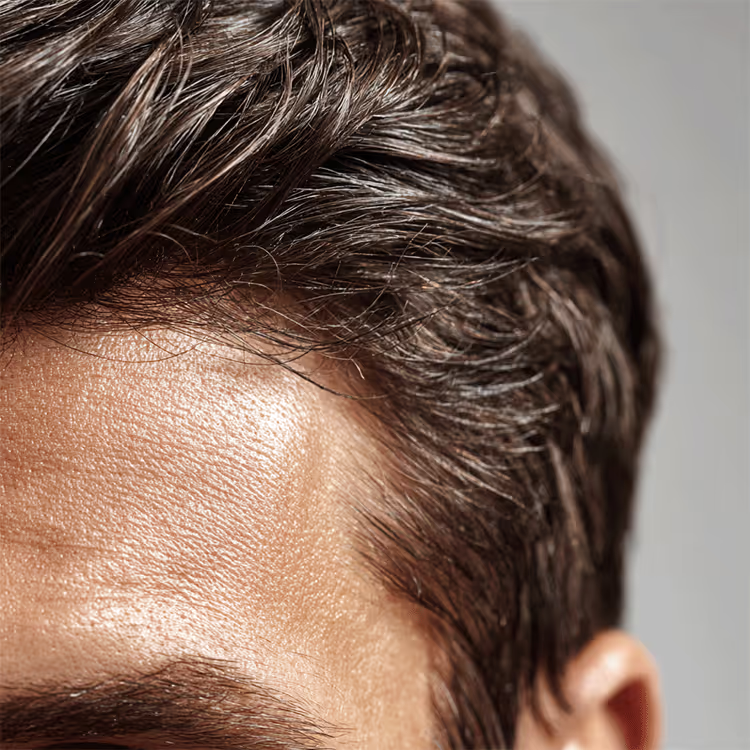
Every hair goes through a growth cycle. In men with hereditary hair loss, DHT, a byproduct of testosterone, disrupts that cycle: hair follicles shrink, the growth phase shortens, and eventually, the hair stops growing altogether. That process starts earlier than most men think and is irreversible if you wait too long. More about how DHT and hair loss work can be found here.
The two treatments that actually work
1. Finasteride — tackles the root cause
Finasteride blocks the enzyme that converts testosterone into DHT. Less DHT means less damage to the hair follicles. Large clinical studies show that finasteride stops hair loss in 83–87% of men and actually stimulates new hair growth in 66%. Those are numbers no supplement even comes close to.
Finasteride is available by prescription and works best if you start early. Read more about the finasteride timeline or everything about finasteride for hair loss.
2. Minoxidil — directly stimulates the hair follicles
Minoxidil improves blood circulation to the hair follicles and extends the growth phase. The topical version is EMA-approved and available over the counter, while the oral version is prescribed off-label and is only available with a doctor's prescription.
Topical (lotion or foam): is applied directly to the scalp twice a day. It is effective, but requires consistency and can cause local skin irritation in some men.
Oral (pill): a low daily dose via a tablet, with the advantage that it works systemically and is easier to use. It is being researched and applied more and more, including for men who do not tolerate topical minoxidil as well. Read more about oral minoxidil pills.
Which form suits you best depends on your situation and preference.
3. The combination: the best result
Finasteride and minoxidil work through different mechanisms and complement each other. Studies consistently show that the combination provides significantly better results than either treatment alone. For those who are serious about getting started, this is the gold standard. More about the combination of finasteride and minoxidil.
Supplements, shampoos, and oils: an honest answer
Most products you come across online, such as biotin supplements, caffeine shampoos, rosemary oil, or keratin powders, have one thing in common: there is no clinical evidence that they stop hair loss or stimulate hair growth in healthy people.
Biotin and other nutritional deficiencies can cause hair loss, that is true. But an actual deficiency is extremely rare in a Western context. If you eat a normal diet, you do not have a biotin deficiency, and taking extra will not change anything about your hair. The supplement industry cleverly plays on that insecurity, but the science is clear: if there is no deficiency, it does not help.
The same applies to caffeine shampoos and rosemary oil. They perform well on social media, but are completely absent from the clinical literature that actually matters.
Conclusion
There are two proven ways to stimulate hair growth: finasteride and minoxidil. Everything else is just noise. The combination of both provides the best result, and the sooner you start, the more you can retain or regain.
Ready to get started?
At 3CO, you start an online consultation that is reviewed within 24 hours by a licensed physician. If the treatment is safe for your situation, it will be delivered discreetly to your home within 5 business days. This way, you get quality care, right from home.
Sources
Kaufman KD et al. (1998). Finasteride in the treatment of men with androgenetic alopecia. JAAD, 39(4), 578–589. PubMed
Messenger AG & Rundegren J (2004). Minoxidil: mechanisms of action on hair growth. British Journal of Dermatology, 150(2), 186–194. PubMed
European Medicines Agency (EMA). Summary of Product Characteristics: Minoxidil. ema.europa.eu
NHS (2023). Hair loss. National Health Service (UK). nhs.uk