3K+ happy customers
Unlimited contact with doctors
100% online
Fast and discreet delivery
Dutch pharmacies


How much hair loss is normal per day?
Most people lose about 50 to 100 hairs a day. This is normal and usually has no visible effect on the thickness of your hair, because new hairs are growing at the same time.

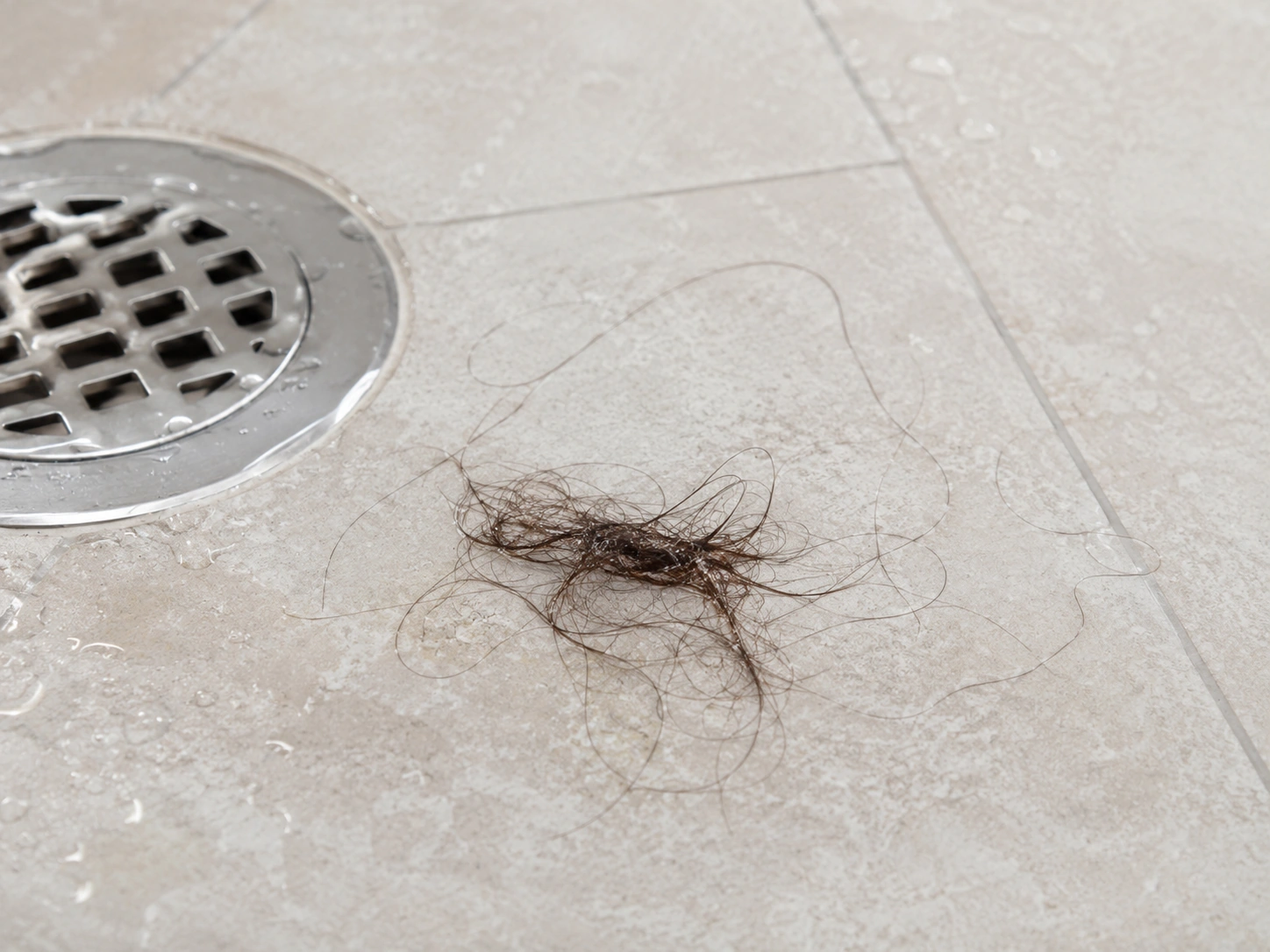
A clump of hair in the shower drain or extra hair in your brush can be alarming. But when is hair loss normal and when are you losing too much? In this article, you will read how much hair you normally lose per day, why it often seems like more in the shower, and which signs are reason to have the cause evaluated.
In short
| Normal per day | Around 50 to 100 hairs, sometimes slightly more. |
|---|---|
| In the shower | It often looks like more because loose hairs from several days come out at once. |
| Why hairs fall out | Old hairs are released at the end of their natural growth cycle. |
| More important than counting | Watch whether your hair sheds more for weeks or visibly thins. |
| Have it assessed | With sudden shedding, bald patches or scalp complaints. |
How much hair do you normally lose per day?
Most people lose about 50 to 100 hairs daily. On some days, this can be a bit more, for example when you wash your hair.
The exact number varies per person and is difficult to count. It is therefore more important to pay attention to changes in your hair itself over a longer period. If your hair remains about as full, daily hair loss is usually normal. If your hair is visibly thinning or you are losing much more than you are used to for weeks at a time, something else may be going on.
How much hair loss in the shower is normal?
In the shower, many loose hairs are released at once. Hairs that had already detached can get stuck between other hairs and only wash out while you are shampooing.
If you wash your hair a few times a week, you may see the hair loss of several days all at once on wash day. As a result, the amount may seem larger than it actually is.
This is especially noticeable with long or curly hair. Long hairs form a large clump more quickly, and curls hold onto loose hairs for longer.
Why do you lose hair every day?
Every hair goes through a natural growth cycle with three phases.
During the growth phase, the hair grows for several years. This is followed by a short transition phase. In the resting phase, growth stops and the hair eventually detaches. A new hair can then grow from the same hair follicle.
Not all hairs are in the same phase at the same time. As a result, you lose a small number of hairs every day, while the rest continue to grow.
When is hair loss too much?
Pay close attention to changes compared to what is normal for you. The following signs may indicate that something more is going on:
• You have been losing significantly more hair than normal for several weeks.
• Your hair is becoming visibly less full.
• Your crown, hairline, or the top of your head is gradually thinning.
• A noticeable amount of hair comes loose when touched lightly or while combing.
• Round or sharply defined bald patches are appearing.
Is your hair gradually thinning, especially on top? Read about thinning hair.
Temporary or hereditary hair loss?
More hair loss than usual can be temporary or permanent.
After illness, severe stress, surgery, rapid weight loss, or other physical strain, a large amount of hair can fall out all at once. This often begins two to three months after the event and is usually spread across the entire scalp. This type of hair loss often resolves on its own once the cause has been addressed.
Hereditary hair loss follows a different pattern. Individual hairs gradually become finer and shorter. This usually occurs at the temples, hairline, crown, and top of the head. Hereditary hair loss generally does not resolve on its own.
Unsure which type applies to you? Read about hair loss due to stress or genetics or view the overview in hair loss in men.
When should you see a GP or doctor?
Have your hair loss evaluated if:
• the hair loss starts suddenly and severely
• bald patches appear
• your hair is visibly thinning
• your scalp is red, painful, itchy, or flaky
• the hair loss is accompanied by fatigue, weight changes, or other symptoms
If you are worried or unsure about the cause, a doctor can also help assess the pattern.
Are you concerned about your hair loss?
At 3CO, you can start an online consultation. You fill out a medical questionnaire, after which a registered physician assesses whether your hair loss is likely hereditary and whether treatment is suitable and safe for you.
Frequently asked questions about normal hair loss
How much hair do you normally lose per day?
Most people lose around 50 to 100 hairs a day, sometimes slightly more. This is normal as long as your hair stays roughly as full over time.
Is 100 hairs a day too many?
No. Around 100 hairs a day falls within the usual guideline. What matters most is noticing a clear change compared with what is normal for you.
How much hair loss in the shower is normal?
In the shower, loose hairs from several days can come out at once. A larger clump can therefore be normal, especially if you do not wash your hair daily or have long or curly hair.
Should I count the hairs I lose?
Usually not. The exact number is hard to count reliably. Instead, watch for changes in how much hair you lose and for visibly thinning areas.
When is hair loss too much?
Have the cause assessed if you lose noticeably more hair for weeks, your hair visibly thins, bald patches appear, or many hairs come out with a light touch.
How do I know if my hair loss is temporary?
Temporary hair loss often starts a few months after illness, stress or another physical strain and is usually spread across the whole scalp. Hereditary hair loss develops gradually and often follows a recognisable pattern.
Why do I lose more hair on a wash day?
Loose hairs can stay caught among the other hairs and only come out during washing. That is why on a wash day you sometimes see several days of shedding at once.
When should I see a doctor about hair loss?
Have your hair loss assessed in case of sudden or heavy shedding, bald patches, visible thinning, or symptoms such as redness, pain, itching and flaking on the scalp.
Sources
- Ho CH, Sood T, Zito PM. Androgenetic Alopecia. StatPearls, NCBI Bookshelf, 2024.
- Hughes EC, Saleh D. Telogen Effluvium. StatPearls, NCBI Bookshelf.
- Hair loss and Telogen effluvium. DermNet NZ.
- Dutch College of General Practitioners. NHG Treatment Guideline for Alopecia.
- Pharmacotherapeutic Compass. National Health Care Institute.