3K+ happy customers
Unlimited contact with doctors
100% online
Fast and discreet delivery
Dutch partner pharmacy

Stopping hair loss: What really works?
Once you notice that your hair is thinning, you often only want one thing: stop it. And then the search begins. Shampoos, supplements, natural DHT blockers, laser pens, rosemary oil. the internet is full of them. But what really works? In this article, we'll give you an honest, science-based overview of what can actually stop hair loss, and what great marketing is.
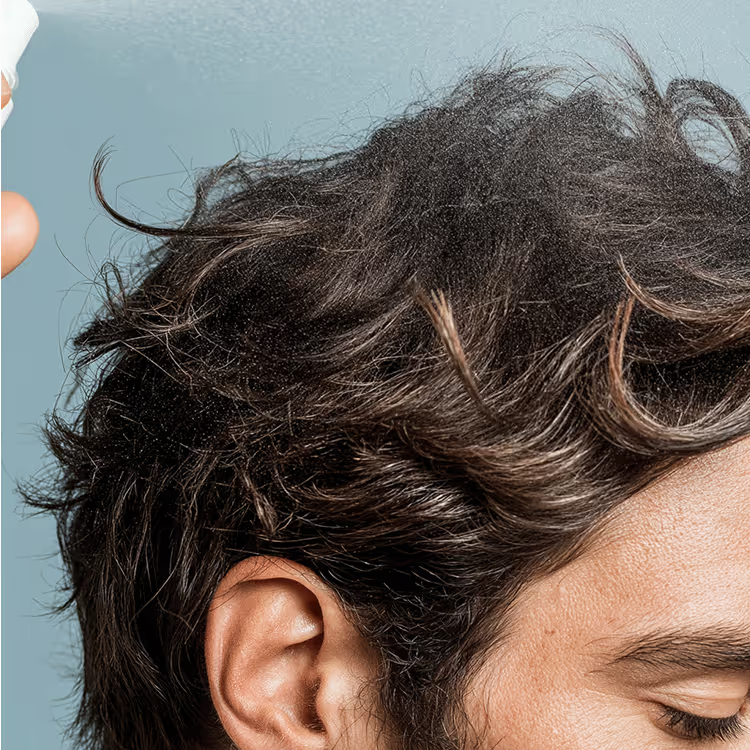
1. First: what kind of hair loss do you have?
Not all hair loss is the same, and not all treatments work for every form.
The most common form by far, among around 95% of men and a large proportion of women, is hereditary baldness (androgenetic alopecia). This is the type where DHT attacks hair follicles. All treatments in this article mainly focus on this form.
Do you suddenly have bald spots, or did your hair loss start recently and sharply after a stressful period? Then something else may be going on. In that case, consult a doctor.
2. What has been proven to work: finasteride
Finasteride is the only drug approved by the FDA and the EMA for the treatment of hereditary baldness in men. It works by inhibiting the enzyme 5-alpha reductase, which decreases DHT production by approximately 70%.
In clinical trials, hair loss stopped or slowed at 90% of men who used finasteride. A significant part even saw her grow back.
Finasteride works best when you start early, at the first signs of hair loss. It stops progression but can't restore really lost follicles.
Read more: Finasteride against hair loss
3. What works proven: minoxidil
Minoxidil was originally a blood pressure medication, but has grown into one of the most used hair loss treatments worldwide. It works differently than finasteride: instead of blocking DHT, it stimulates blood flow to the hair follicles and prolongs the growth phase of the hair.
Oral minoxidil (in pill form) is the newer and increasingly popular variant. In 2024, 43 international experts came in JAMA Dermatology concluded that low doses of oral minoxidil are effective and safe for both men and women.
Minoxidil works best in combination with finasteride (for men).
Read more: Minoxidil hair loss pills
4. The combination: the best result
The strongest scientific basis is there for combination of finasteride and minoxidil. Finasteride addresses the cause (DHT), minoxidil stimulates growth. Studies consistently show better results for the combination than for each drug alone.
At 3CO, the combination therapy is available as a spray and in pill form, with a doctor's prescription via an online consultation.
Read more: Finasteride & Minoxidil: The Most Effective Combination?
5. Which hardly works or is mainly marketing
Many “natural” hair loss solutions sound appealing, but have little serious scientific evidence.
Rosemary oil is often mentioned as an alternative to minoxidil, based on one small, limited-quality study. There is no convincing evidence that it really works for hereditary baldness. The idea that it is similar to minoxidil is misleading.
Laser treatments such as LLLT are presented as high-tech solutions, but the effects in studies are small and inconsistent. In practice, the results are disappointing, especially when compared to proven medication.
So-called natural DHT blockers such as saw palmetto are also widely sold, but there is no strong evidence that they lower DHT enough to stop hair loss. The operation is unreliable and often negligible.
Dietary supplements such as biotin, zinc or iron only help if you are actually deficient. In all other cases, they do nothing for hereditary baldness. You just pee them out again.
6. What doesn't work
Anti-hair loss shampoos improve the condition of your hair, but do not stop hair loss. Oils such as castor oil or coconut oil have no proven effect. Caffeine shampoos show conflicting and minimal results. Many hair growth vitamins are primarily marketing. PRP injections are still insufficiently substantiated for broad application.
7. How do you get started?
The best thing to do with the first signs of hair loss: act quickly. The more follicles that are still active, the more effective the treatment.
At 3CO, you will go through an online consultation, assessed by a BIG-registered doctor, within a few minutes. Once approved, you will receive your medication discreetly at home, directly from a Dutch pharmacy.
Are you ready? Start your free consultation.
Scientific sources
- Kaufman, K.D. (2002). Androgens and alopecia. Molecular and Cellular Endocrinology.
- Panahi, Y., et al. (2015). Rosemary oil vs minoxidil 2% for the treatment of androgenetic alopecia. Skinmed, 13 (1), 15—21.
- Yagiz, M. A., et al. (2024). Low-Dose Oral Minoxidil Initiation for Patients With Hair Loss. JAMA Dermatology.
- Leavitt, M., et al. (2009). HairMax LaserComb laser phototherapy device in the treatment of male androgenetic alopecia. Clinical Drug Investigation, 29 (5), 283—292.