3K+ happy customers
Unlimited contact with doctors
100% online
Fast and discreet delivery
Dutch partner pharmacy

Androgenetic alopecia: cause and treatment
Androgenetic alopecia is the medical term for hereditary hair loss and is the most common form of hair loss in both men and women. It is estimated to cause approximately 95% of permanent baldness in men. It usually begins with deepening temples, a receding hairline, or a thinning crown. On this page, you will learn how androgenetic alopecia develops, how to recognize it, and what you can do about it. We also explain how it differs from other forms of hair loss, such as alopecia areata.

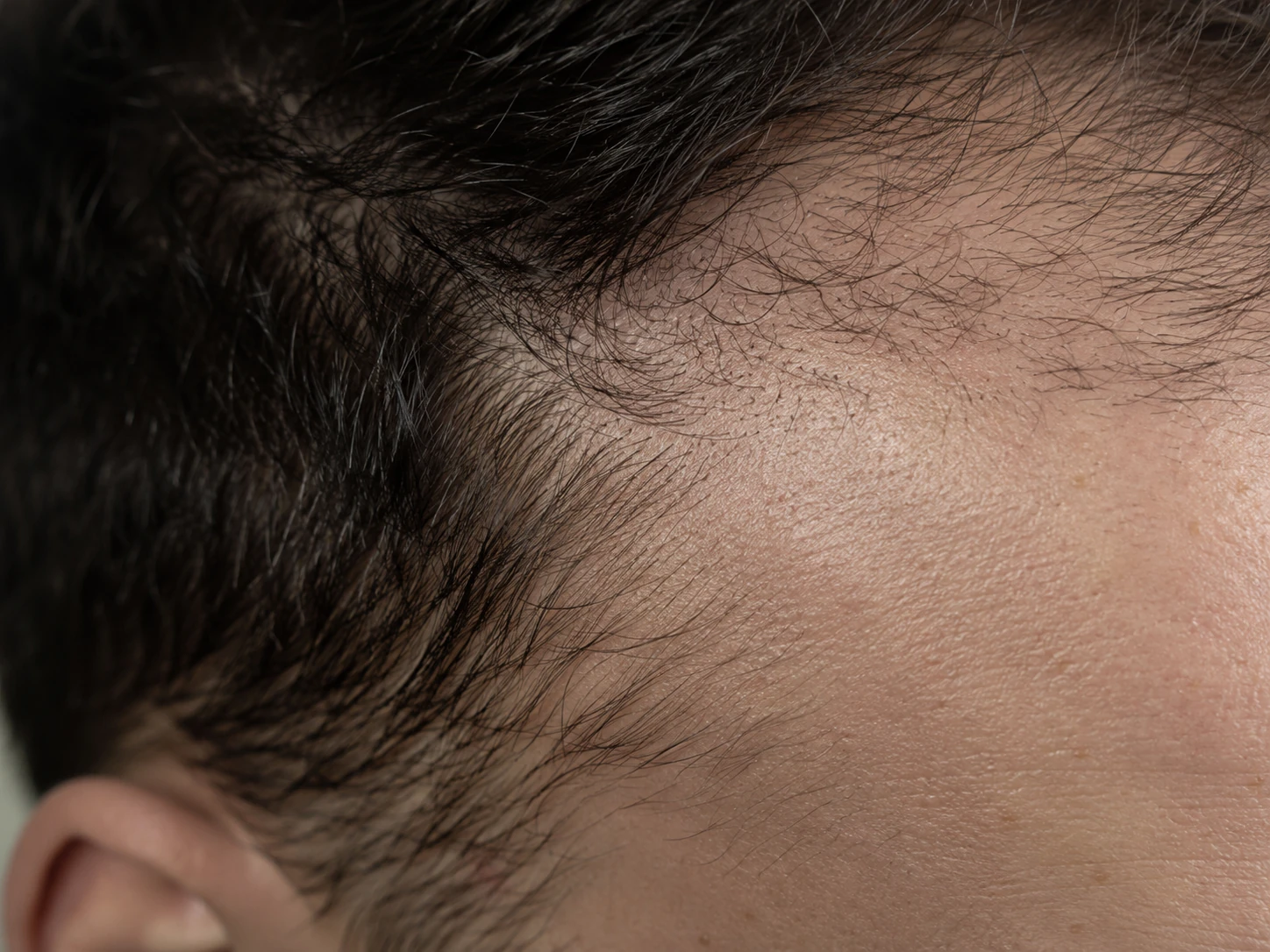
What is androgenetic alopecia?
The name itself says a lot. "Androgenetic" refers to androgens—male sex hormones like DHT—and to genetic predisposition. In androgenetic alopecia, certain hair follicles are hereditarily more sensitive to DHT. As a result, the hairs gradually become thinner and may eventually disappear.
It is usually not a sign of an underlying health problem. Nevertheless, hereditary hair loss can have a significant psychological and emotional impact. Just because it is medically harmless does not make it any less distressing for those who experience it.
How does androgenetic alopecia develop?
Androgenetic alopecia occurs because certain hair follicles are hereditarily sensitive to DHT. DHT is a hormone derived from testosterone.
In sensitive hair follicles, DHT causes them to slowly shrink. This makes the hairs increasingly thinner and shorter until they are eventually barely visible. This process is called miniaturization.
In men, the hair follicles at the temples and on the crown are particularly sensitive to DHT. This is why hereditary hair loss often begins with deepening temples or a thinning crown.
It is usually not a matter of having too much DHT, but rather how sensitive your hair follicles are to this hormone. On our page about DHT you can read more about this.

How do you recognize androgenetic alopecia?
You can recognize androgenetic alopecia by a gradual and predictable pattern of hair loss. That pattern differs between men and women.
In men, it usually starts with deepening temples and thinning hair on the crown. Over time, these areas can grow larger and eventually merge. The hair on the sides and back is usually retained for longer. You can read more about this in our article on hair loss in men.
In women, hair typically thins gradually around the part and on the top of the head. The front hairline usually remains intact, and complete baldness is rare. You can read more about this in our article on hair loss in women.
Because the process is gradual, it often goes unnoticed for a long time. Early detection is important, as it is generally easier to maintain existing hair than to regrow hair that has been gone for a long time.

How common is it?
Androgenetic alopecia is by far the most common form of hair loss. For men, the following rule of thumb is often used: about 20 percent by age twenty, 30 percent by age thirty, 40 percent by age forty, and 50 percent by age fifty.
For women, about 12 percent experience it before menopause. After menopause, this figure rises to about half.
So, you are far from alone, even if it often feels that way.
Is it the same as other types of hair loss?
Not every form of hair loss is androgenetic alopecia. The distinction is important because treatments vary depending on the cause.
With alopecia areata , hair falls out suddenly in round, bald patches. This is caused by an autoimmune reaction and follows a different pattern than hereditary hair loss.
With telogen effluvium , hair falls out temporarily and diffusely. This can happen after stress, illness, childbirth, or a strict diet, for example. Often, the hair recovers on its own afterward.
Not sure if your hair loss is hereditary or caused by something else? Read more in our article about hair loss due to stress or genetics.
How is it diagnosed?
A doctor can often identify androgenetic alopecia by asking questions and ruling out other causes. When there is a gradual deepening of the hairline and a thinning crown, with no scalp symptoms, the diagnosis can usually be made based on the pattern and progression.
Are there round bald patches, itching, redness, flaking, or scarring on the scalp? Or did the hair loss begin after a major stressful event, illness, or childbirth? In these cases, further investigation is often necessary, and a referral to a specialist may be advisable.
Can androgenetic alopecia be treated?
Androgenetic alopecia cannot be cured, but it can be treated. The goal is to slow down further hair loss, preserve existing hair, and sometimes regain some hair growth.
The two most well-researched treatments are finasteride and minoxidil. Finasteride lowers DHT, thereby addressing the primary cause of hereditary hair loss in men. Read more on our page about finasteride.
Minoxidil stimulates hair growth and can keep hair in the growth phase for longer. Read more on our page about minoxidil.
For women, we currently only offer oral minoxidil. We do not offer finasteride to women because scientific research into its efficacy and safety for women is still too limited.
How 3CO treats androgenetic alopecia
If you suspect you have androgenetic alopecia, treatment always begins with a medical assessment. At 3CO, this process is entirely online. You complete a medical questionnaire, and a licensed physician reviews your request individually to determine if, and which, treatment is right for you. If approved, our partner pharmacy prepares the medication and it is delivered to your home.
Curious if a treatment is right for your situation? Start an online consultation. A doctor will review your request.
Frequently asked questions about androgenetic alopecia
What is androgenetic alopecia?
Androgenetic alopecia is the medical name for hereditary hair loss. It is the most common form of hair loss in men and women. In men it usually causes deepening receding temples and a balding crown. In women the hair mainly thins around the parting and on top of the head.
How does androgenetic alopecia develop?
Androgenetic alopecia develops because certain hair follicles are genetically sensitive to DHT, a hormone formed from testosterone. DHT slowly shrinks sensitive follicles, so the hairs become progressively thinner and shorter. This process is called miniaturisation.
Is androgenetic alopecia the same as hereditary hair loss?
Yes. Androgenetic alopecia is the medical term for hereditary hair loss. It is also called male pattern baldness or female pattern hair loss.
How do you recognise androgenetic alopecia?
You usually recognise it by gradual hair loss in a fixed pattern. In men, the temples often recede further and the hair at the crown thins. In women, the parting mainly widens and the hair on top of the head thins. The scalp usually looks normal.
What is the difference from alopecia areata and telogen effluvium?
With alopecia areata, hair often falls out suddenly in round bald patches. With telogen effluvium, hair sheds across the whole head, often after stress, illness, childbirth or a strict diet. Androgenetic alopecia, by contrast, develops gradually and usually follows a recognisable pattern.
How is androgenetic alopecia diagnosed?
A doctor can often recognise androgenetic alopecia by asking questions and assessing the pattern and course. With gradually deepening receding temples or a balding crown and no scalp symptoms, further testing is usually unnecessary. With round bald patches, sudden hair loss, itching, redness, flaking, scarring or a major recent stressor, additional tests or referral to a specialist may be needed.
At what age does androgenetic alopecia start?
This varies per person. For men, the following rule of thumb is often used: about 20 percent around age twenty, 30 percent around thirty, 40 percent around forty and 50 percent around fifty. Among women, about 12 percent are affected before menopause. After menopause this rises to roughly half.
Can androgenetic alopecia be cured?
Androgenetic alopecia cannot be cured, but it can be treated. The aim is to slow further hair loss, preserve existing hair and sometimes regain some growth. Treatment only works as long as you continue it. After stopping, hereditary hair loss usually resumes.
What treatments are available for men?
The two best studied treatments are finasteride and minoxidil. Finasteride lowers DHT and thereby targets the main cause of hereditary hair loss in men. Minoxidil stimulates hair growth and can keep hairs in the growth phase longer. These treatments can be used separately or together, depending on the medical assessment.
What treatment do you offer women?
For women we currently only offer oral minoxidil. We do not offer finasteride to women, because the scientific research on its effect and safety in women is still too limited. A doctor always assesses whether oral minoxidil is suitable and safe.
SOURCES
- Ho CH, Sood T, Zito PM. Androgenetic Alopecia. StatPearls, NCBI Bookshelf, 2024.
- Sinclair R, Torkamani N. Male androgenetic alopecia. Endotext, NCBI Bookshelf.
- Azzouni F, Godoy A, Li Y, Mohler J. The 5 alpha-reductase isozyme family: a review of basic biology and their role in human diseases. Advances in Urology. 2012;2012:530121.
- Kelly Y, Blanco A, Tosti A. Androgenetic alopecia: an update of treatment options. Drugs. 2016;76(14):1349–1364.
- Dutch College of General Practitioners. NHG Treatment Guideline for Alopecia.
- Pharmacotherapeutic Compass. Finasteride for alopecia and minoxidil. National Health Care Institute.