3K+ happy customers
Unlimited contact with doctors
100% online
Fast and discreet delivery
Dutch partner pharmacy

Balding crown: recognition, causes, and treatment
A thinning crown often goes unnoticed for a long time because it is difficult to see yourself. In men, gradual hair loss at the crown is usually a sign of hereditary hair loss. In this article, you will learn how to identify a thinning crown, how it differs from a natural hair whorl, and what you can do about it.

In short
| What do you see? | Increasingly visible scalp around the hair whorl. |
|---|---|
| Surrounding hairs | Become thinner, shorter and less dense. |
| Most common cause | Hereditary hair loss. |
| Not always baldness | With a normal hair whorl, scalp can also be visible. |
| Approach | Assessing early gives the best chance of preserving hair. |
What is a thinning crown?
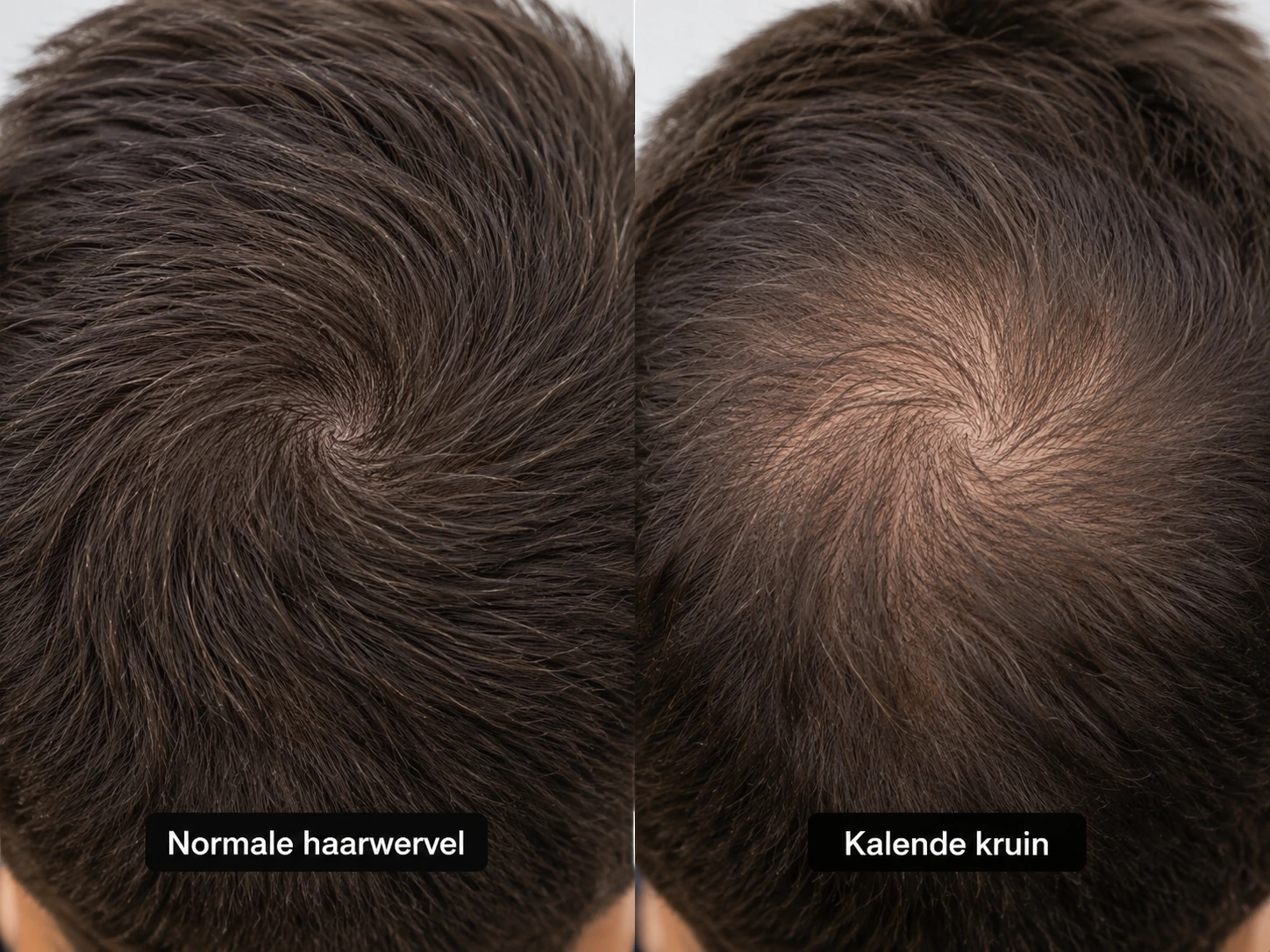
The crown is the area around the hair whorl at the top of the head. With a thinning crown, the hair in this area gradually becomes thinner. At first, you usually won't see a completely bald spot, but rather more of the scalp showing through the hair.
The spot often starts in the center of the whorl and slowly spreads outward. As this happens, the hairs become increasingly thinner and shorter. This process is called miniaturization and is characteristic of male pattern baldness.
Natural hair whorl or thinning crown?
It is normal for some scalp to be visible around a hair whorl. This is especially noticeable in bright light, with wet hair, short hair, or a strong whorl. This does not necessarily mean you are developing a bald crown.
The most important difference is the progression. A natural hair whorl remains roughly the same. With hair loss at the crown, an increasingly larger area becomes visible, and the hairs around the whorl become thinner and shorter.
| Characteristic | Normal hair whorl | Balding crown |
|---|---|---|
| Scalp | Mainly visible in the middle. | Visible over an increasingly large area. |
| Surrounding hairs | Stay thick, long and strong. | Become thinner, shorter and finer. |
| Course | Stays roughly the same for years. | Gradually gets larger. |
| Other areas | Hairline and top of the head remain stable. | The temples or top of the head may thin as well. |
Take a photo from directly above every few months. Always use dry hair, the same lighting, the same distance, and roughly the same hair length. This allows you to compare the progression accurately.
Why does the crown thin out specifically?
In hereditary hair loss, certain hair follicles are sensitive to dihydrotestosterone, better known as DHT. The crown, hairline, and temples are often the areas most sensitive to this.
Under the influence of DHT, the growth phase of sensitive hair follicles shortens. The follicles shrink and produce increasingly finer and shorter hairs. Eventually, the hairs may become barely visible.
The hair on the sides and back of the head is usually less sensitive to DHT. That is why a wreath of stronger hair often remains there. You can read more about this in DHT and hair loss in men.
How to spot a thinning crown
You can usually identify an early thinning crown by a combination of changes:
- More of the scalp becomes visible around the hair whorl.
- The thin spot gradually grows larger.
- The hair around the whorl becomes shorter and finer.
- The crown looks less dense, even in normal light.
- Sometimes, receding temples or thinning hair on top also develop.
A thinning crown is one pattern of hereditary hair loss. Other patterns may point to a different cause.
| Pattern | Where do you see it? | What fits this? |
|---|---|---|
| Balding crown | Around the hair whorl. | Usually hereditary hair loss. |
| Receding hairline | At the temples and forehead. | Usually hereditary hair loss. |
| Diffusely thinning hair | Spread across the top of the head. | Hereditary or temporary hair loss. |
| Round bald patch | A sharply defined patch. | Possibly alopecia areata. |
Is the hair loss mainly at your hairline? Then read about receding hairlines and temple thinning. Is your hair getting thinner all over the top? Then check out thinning hair. Are you unsure if stress is a factor? Read hair loss due to stress or genetics.
Is a bald spot on the crown always hereditary?
No. In men, a slowly enlarging, round or oval spot is usually consistent with hereditary hair loss. A sudden or sharply defined bald spot may have a different cause.
Have the spot evaluated if the hair loss occurs suddenly or is accompanied by:
- redness or flaking;
- itching, pain, or a burning sensation;
- sores or inflammation;
- completely smooth, sharply defined bald patches;
Such symptoms may indicate conditions like alopecia areata or a scalp disorder.
Can a thinning crown grow back?
Hereditary hair loss does not go away on its own, but it can often be slowed down. Thinning hair can sometimes become thicker and longer again, as long as the hair follicles are still active.
A crown that has been completely bald and smooth for a long time usually responds less well to treatment. Therefore, maintaining existing hair is often easier than regrowing hair that has been gone for a long time.
What helps with a thinning crown?
Finasteride and minoxidil are among the most well-researched treatments for male pattern baldness.
Finasteride
Finasteride reduces the production of DHT. In doing so, it targets a primary cause of hereditary hair loss. The main goal is to slow down further miniaturization and preserve existing hair. Sometimes, hair on the crown can also grow back thicker.
Minoxidil
Minoxidil stimulates hair growth and can help strengthen thinning hair. Minoxidil is commonly available as a lotion or foam. At 3CO, it can also be prescribed off-label as a tablet following a medical assessment. You can read about the difference in oral versus topical minoxidil.
What does not work for a thinning crown
Shampoos, oils, and supplements can sometimes make hair appear fuller temporarily, but they do not treat the underlying cause of hereditary hair loss. You can find an overview of all treatment options and their effectiveness in what to do about hair loss.
Online consultation for a thinning crown
Do you think your crown is thinning due to hereditary hair loss? You can start an online consultation at 3CO.
You fill out a medical questionnaire. A BIG-registered doctor will then assess whether a treatment is suitable and safe for you. If approved, the medication will be delivered to your home via our partner pharmacy.
Frequently asked questions about a thinning crown
Is a balding crown always hereditary?
No. In men, a gradually balding crown is usually caused by hereditary hair loss. A sudden or sharply defined bald patch may have another cause.
How do I know if my crown is really thinning?
Compare photos with dry hair, the same lighting and the same hair length. With hair loss, an increasingly large area becomes visible and the hairs around the whorl become thinner and shorter.
Can a balding crown fill in again?
Hairs that have become thinner can sometimes thicken again. A crown that has been completely bald and smooth for a long time is harder to restore.
At what age does a balding crown start?
Hereditary hair loss can start after puberty. In some men the crown already thins during early adulthood, while in others this happens only later.
Does finasteride help against a balding crown?
Finasteride lowers DHT and can slow hereditary hair loss. A doctor assesses whether the medication is suitable and safe for you.
Does minoxidil help against hair loss at the crown?
Minoxidil stimulates hair growth and can help strengthen hairs that have thinned. The result varies per person and usually only becomes visible after several months.
Can stress cause a bald spot on the crown?
Stress usually causes diffuse hair loss across a larger part of the head. A slowly expanding area around the hair whorl fits hereditary hair loss better.
When should I see a doctor about a bald patch?
Have the area assessed if the hair loss appears suddenly or comes with redness, itching, pain, flaking, sores or sharply defined bald patches.
Sources
- Ho CH, Sood T, Zito PM. Androgenetic Alopecia. StatPearls, NCBI Bookshelf, 2024.
- Male Androgenetic Alopecia. Endotext, NCBI Bookshelf.
- Androgenetic Alopecia. MedlinePlus Genetics, U.S. National Library of Medicine.
- Androgenetic Alopecia. DermNet NZ.
- Dutch College of General Practitioners. NHG Clinical Guideline on Alopecia.
- Pharmacotherapeutic Compass. National Health Care Institute.