3K+ happy customers
Unlimited contact with doctors
100% online
Fast and discreet delivery
Dutch pharmacies


Thinning hair in men: causes and treatment
Is your hair gradually thinning at the crown, hairline, or the top of your head? Hereditary hair loss is usually the cause. The hair follicles slowly shrink, causing the hair that grows back to become finer and shorter. This is different from sudden hair loss following stress or illness. In those cases, hair doesn't usually become finer; instead, a large amount of hair falls out temporarily across the entire scalp.

In short
| What happens? | With each growth cycle the hairs become finer, shorter and less visible. |
|---|---|
| Most common cause | Hereditary hair loss, also called androgenetic alopecia. |
| Recognition | Gradual thinning at the crown, hairline, temples or top of the head. |
| Other possibility | Sudden diffuse shedding after stress, illness or another physical strain. |
| Treatment | Hereditary hair loss can often be slowed and sometimes partly restored. |
What does thinning hair mean?
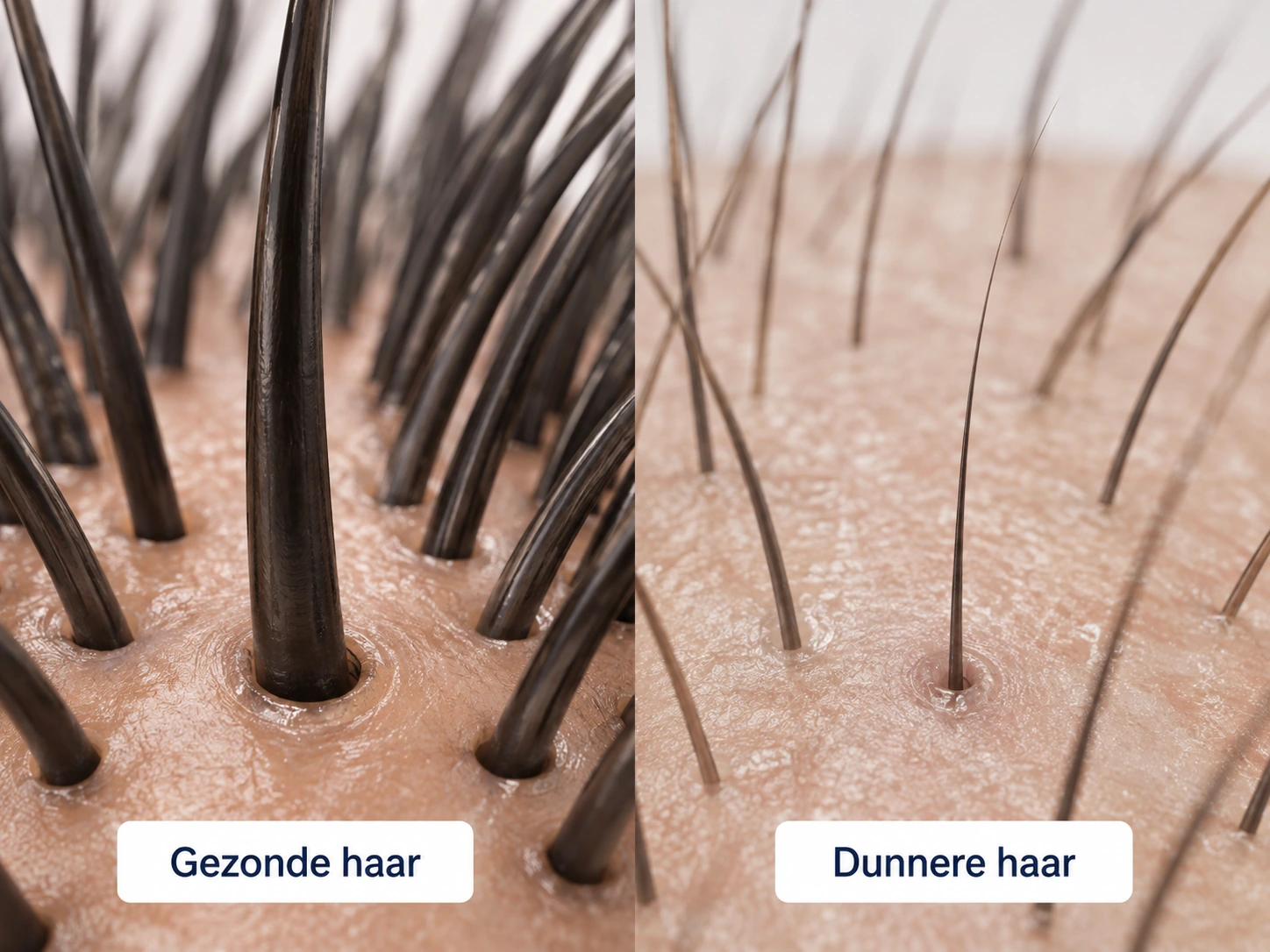
With thinning hair, individual strands become finer, shorter, and less visible. As a result, your hair loses volume and the scalp becomes more visible.
This process is called miniaturization. With every growth cycle, the hair follicle produces a thinner hair until it is barely noticeable. In men, this is the primary sign of hereditary hair loss, also known as androgenetic alopecia or male pattern baldness.
Losing fifty to a hundred hairs a day is normal. These hairs are usually replaced by new ones of roughly the same thickness. With hereditary hair loss, however, the new hairs grow back thinner each time.
Why does hair thin in men?
The most common cause is a hereditary sensitivity to dihydrotestosterone, or DHT for short. This hormone binds to sensitive hair follicles, causing them to gradually shrink.
Not all hair follicles are equally sensitive to DHT. That is why hereditary hair loss usually begins at the temples, hairline, crown, or the top of the head. The hair on the sides and back often remains thick and full for longer.
The rate at which hair thins varies from person to person. For some men, it remains limited to slight receding at the temples for years. For others, the thinning progresses more rapidly.
You can read more about this in our article on DHT and hair loss in men.
How do you recognize hereditary hair loss?
Thinning hair is likely related to hereditary hair loss if:
- the crown area slowly appears larger or lighter
- the temples are gradually receding
- the hairline is slowly moving backward
- you see more and more of your scalp at the top
- more and more short, fine hairs are growing among the normal hairs
- the hair on the sides and back remains clearly fuller
- the change occurs gradually over months or years
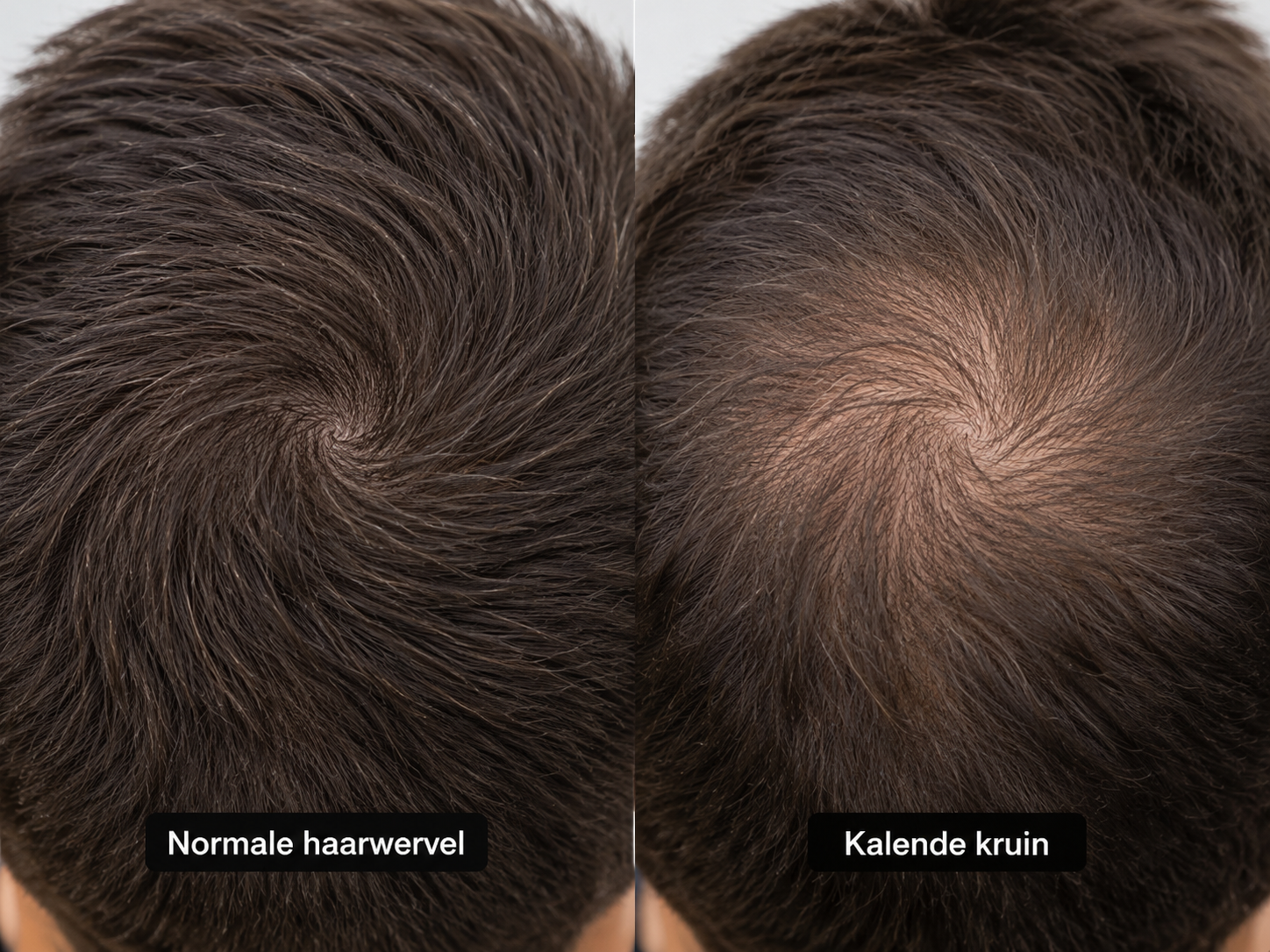
A normal hair whorl can also show some scalp due to the direction of hair growth. With a balding crown, the visible area slowly expands and the hairs around the whorl itself become increasingly thin.
Thinner hairs or thinner hair density?
Thinner hairs and thinner hair density are not exactly the same thing. This distinction helps to differentiate hereditary hair loss from telogen effluvium.
| Characteristic | Hereditary hair loss | Telogen effluvium |
|---|---|---|
| What happens? | The individual hairs become progressively finer and shorter. | Temporarily, more normal hairs fall out at once. |
| Pattern | Mainly at the hairline, temples, crown and top of the head. | Spread across the whole scalp. |
| Course | Gradually over months or years. | Often noticeable and relatively sudden. |
| Trigger | Hereditary sensitivity to DHT. | Often illness, stress, surgery or rapid weight loss. |
| Recovery | Usually does not recover on its own. | Often recovers once the cause is gone. |
With hereditary hair loss, individual hairs gradually become thinner. Your hairstyle slowly loses volume and the scalp becomes more visible, especially at the crown, hairline, or top of the head.
With telogen effluvium, the hairs usually remain normal in thickness, but many more hairs fall out at the same time temporarily. As a result, the overall hair density decreases.
Telogen effluvium often begins two to four months after physical or psychological stress, such as:
- severe stress
- illness or high fever
- surgery
- rapid weight loss
- childbirth
- a change in medication
Hair loss is usually spread across the entire scalp (including the crown) and often recovers once the underlying cause is resolved.
Can thinning hair become thicker again?
That is sometimes possible. As long as a hair follicle is still active, a miniaturized hair can grow thicker and longer with the help of medication.
The chance of recovery is usually higher when hair loss is not yet far advanced. Areas that have been completely bald for a long time generally respond less well.
Without treatment, hereditary hair loss will slowly continue in many men. It is impossible to predict exactly how quickly this will happen.
What can you do about thinning hair?
For hereditary hair loss in men, finasteride and minoxidil are the most well-researched options. Both treatments work in different ways.
Finasteride
Finasteride reduces the conversion of testosterone into DHT. This exposes sensitive hair follicles to less DHT.
The primary goal is to slow down further miniaturization and hair loss. For some men, weakened hairs can also become thicker again.
Minoxidil
Minoxidil stimulates hair growth and can help weakened hairs grow thicker and longer.
At 3CO, oral minoxidil is prescribed off-label. This means the tablet was originally registered for a different use, but can be prescribed by a doctor to treat hair loss.
Combining finasteride and minoxidil
Finasteride targets the influence of DHT, while minoxidil stimulates hair growth. Therefore, the treatments can complement each other.
Initial changes are usually only visible after a few months. A proper assessment often requires six to twelve months. The results achieved are only maintained as long as the treatment is continued.
When should you see a doctor?
Have your hair loss evaluated by a doctor if:
- your hair falls out suddenly and rapidly
- thinning occurs across the entire scalp and crown
- round or sharply defined bald patches appear
- your scalp is red, painful, flaky, or inflamed
- the hair loss is accompanied by fatigue, weight changes, or other symptoms
-
Online consultation for thinning hair
Is your hair thinning and do you want to know if a treatment is right for you? You can start an online consultation at 3CO.
You fill out a medical questionnaire. A BIG-registered doctor will then assess whether your hair loss is likely hereditary and if treatment is safe and suitable for you.
Once approved, the medication will be delivered to your home via our partner pharmacy.
Frequently asked questions about thinning hair
Why is my hair getting thinner?
In men, hereditary hair loss is usually the cause of gradually thinning hair. Hair follicles at the crown, hairline and top of the head are sensitive to DHT and slowly shrink. As a result, progressively finer and shorter hairs grow back.
Is thinning hair the same as going bald?
Thinning hair is often an early stage of hereditary baldness. The hairs are still there but become less visible through miniaturisation. Without treatment this process can continue, although the course differs per person.
Can thinning hair become thicker again?
Sometimes yes. Follicles that are still active can produce thicker hairs again under treatment. Areas that have been completely bald for a long time usually respond less well.
How do I know if my hair is thinning for hereditary reasons?
Hereditary hair loss usually develops gradually at the temples, hairline, crown or top of the head. The hairs there become progressively finer, while the hair at the sides and back often stays fuller.
Can stress make my hair thinner?
Yes. Severe stress, illness or another physical strain can trigger telogen effluvium. A few months later, many hairs temporarily fall out at once across the whole scalp. Unlike hereditary hair loss, the hairs usually do not become gradually finer.
Is a visible scalp always a sign of baldness?
No. With a normal hair whorl, the scalp can be visible because of the direction the hairs grow. With a balding crown, the visible area gradually grows and the hairs around the whorl become progressively finer.
What is the best treatment for thinning hair in men?
For hereditary hair loss, finasteride and minoxidil are the best studied. Finasteride reduces the influence of DHT and minoxidil stimulates hair growth. Which treatment is suitable depends on your medical situation and must be assessed by a doctor.
How quickly do you see results from treatment?
The first changes usually become visible after three to six months. A reliable assessment is often only possible after six to twelve months. In the first weeks or months, temporary extra shedding can occur.
When should I have thinning hair assessed?
Have it assessed if the hair loss starts suddenly, occurs across the whole scalp, causes round bald patches, or comes with itching, redness, pain, flaking or other physical symptoms.
Sources
- Ho CH, Sood T, Zito PM. Androgenetic Alopecia. StatPearls, NCBI Bookshelf, 2024.
- Male Androgenetic Alopecia. Endotext, NCBI Bookshelf.
- Androgenetic alopecia. MedlinePlus Genetics, U.S. National Library of Medicine.
- Androgenetic alopecia. DermNet NZ.
- Grover C, Khurana A. Telogen effluvium. Indian Journal of Dermatology, Venereology and Leprology.
- Telogen effluvium. DermNet NZ.
- Dutch College of General Practitioners. NHG Clinical Practice Guideline on Alopecia.
- Pharmacotherapeutic Compass. National Health Care Institute.