3K+ happy customers
Unlimited contact with doctors
100% online
Fast and discreet delivery
Dutch pharmacies


Going bald at 20: being young and experiencing hair loss
If you notice your hairline receding or your crown thinning at twenty while your peers still have a full head of hair, there is a good chance you are experiencing hereditary hair loss. It feels early—and it is—but it is more common than you might think. In this article, you will read why hair loss can start at a young age, what this means for the future, and why taking action early is worthwhile.

In short
| Is it normal? | Hereditary hair loss can start as early as the teens or twenties. |
|---|---|
| Most common cause | Hereditary sensitivity of the hair follicles to the hormone DHT. |
| First signs | Deeper receding temples, a thinner crown and increasingly fine, short hair. |
| Important | Hair loss that starts early can continue throughout life. |
| Approach | Having it assessed early gives the best chance of keeping existing hair. |
Is it normal to go bald at 20?
Yes, it happens. Hereditary hair loss, also known as androgenetic alopecia, can begin after puberty. For some men, the first signs become visible around the age of eighteen, while for others, it only starts years later.
Hereditary hair loss becomes more common as men age. By the age of thirty, about one in three men has visible hair loss. By the age of fifty, this applies to about half of all men.
The fact that you are already seeing changes at twenty does not mean there is something wrong with you. It primarily means that your genetic predisposition is showing itself early.
Why does hair loss start at a young age?
With hereditary hair loss, certain hair follicles are sensitive to dihydrotestosterone, abbreviated as DHT. This is a hormone derived from testosterone.
Under the influence of DHT, the growth phase of sensitive hair follicles becomes increasingly shorter. The follicles shrink and produce progressively finer and shorter hair. This process is called miniaturization.
How sensitive your hair follicles are and when hair loss begins is largely determined by genetics. If you have a strong predisposition, the process can become visible as early as age 18.
You can read more about this hormone in DHT and hair loss.
How do you recognize early hair loss?
Hereditary hair loss is usually gradual and often follows a recognizable pattern:
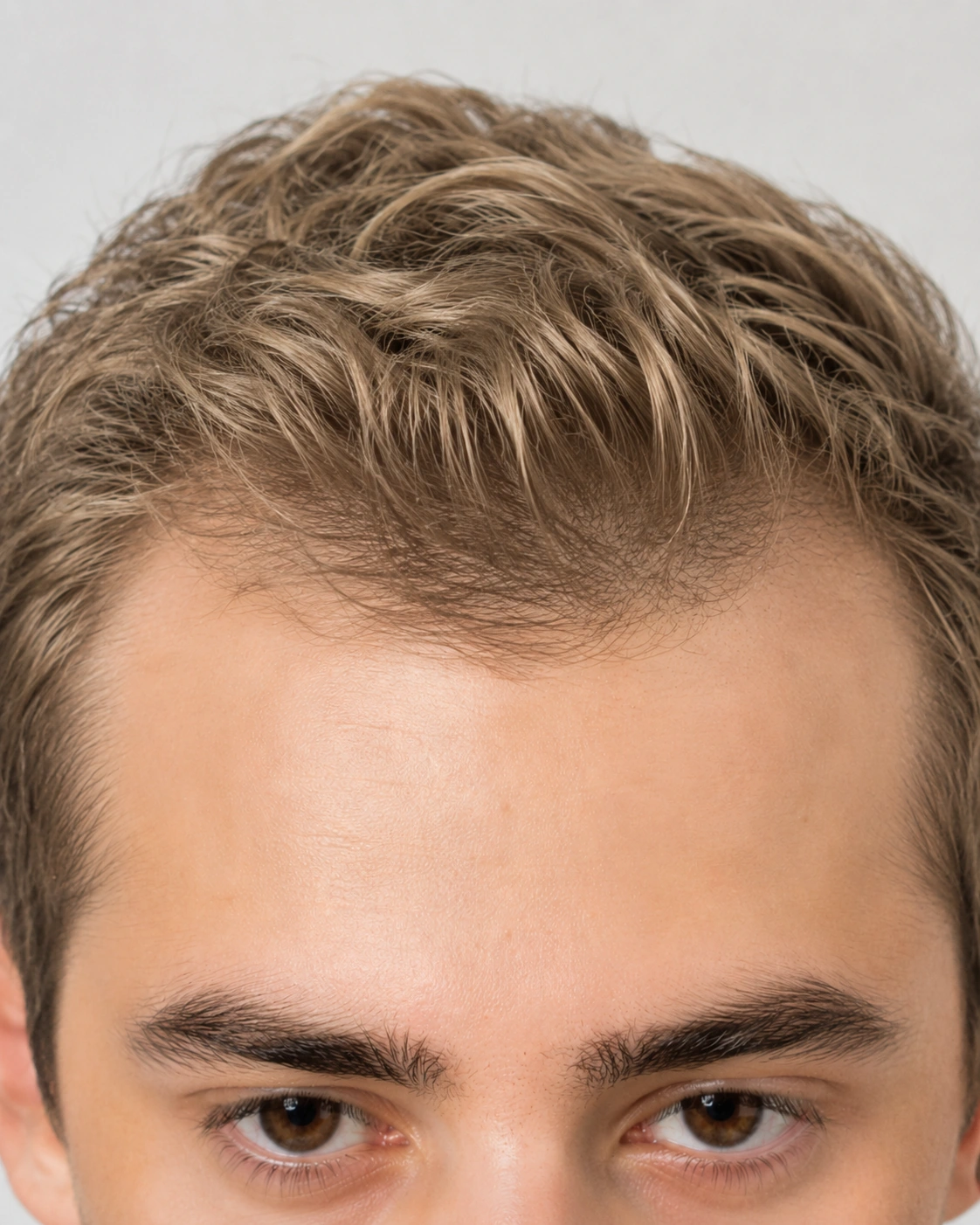
• The hairline recedes at the temples, and deeper corners begin to form.
• The crown becomes thinner, and the scalp becomes more visible.
• The hair on top of the head becomes finer, shorter, and less dense.
Are you wondering if you are starting to lose your hair? In am I going bald you will find a simple self-check to help you recognize the first signs.
What does going bald early mean for the future?
In general, hereditary hair loss can continue to progress when it starts at a young age. How quickly this happens and how much hair someone eventually loses varies greatly from person to person.
Hair loss usually does not happen suddenly, but develops gradually over several years. As a result, there is often time to recognize and treat the process.
Why early intervention makes sense
Retaining existing hair is usually easier than regrowing hair that has been gone for a long time.
As long as hair follicles are still active, weakened hairs can sometimes grow thicker again. When hair follicles have been severely miniaturized for a long time, recovery becomes more difficult.
Starting early therefore primarily means trying to preserve as much existing hair as possible. You can read an overview of the options in what to do about hair loss.
What can you do if you are losing hair at a young age?
The best-researched treatments for hereditary hair loss in men are finasteride and minoxidil.
Finasteride reduces the production of DHT, thereby targeting a major cause of hereditary hair loss. Minoxidil stimulates hair growth and can support weakened hairs.
At 3CO, these treatments are only prescribed after an assessment by a BIG-registered physician. The doctor will evaluate whether the treatment is suitable and safe for you and will discuss the potential side effects.
Online consultation for early hair loss
Think you might be experiencing hereditary hair loss at a young age? You can start an online consultation at 3CO.
First, you fill out a medical questionnaire. Then, a registered physician reviews whether a treatment is suitable and safe for you. Once approved, the medication is discreetly delivered to your home via our pharmacy.
Frequently asked questions about going bald at a young age
Is going bald at 20 normal?
Yes, it happens. Hereditary hair loss can start after puberty and is visible in some men as early as their twenties. This usually points to a genetic predisposition rather than a disease.
At what age does hereditary hair loss usually start?
This varies a lot from person to person. For some men the first signs appear around the age of eighteen. For others, hair loss only becomes visible after thirty or forty.
Can you stop going bald at 20?
Hereditary hair loss usually does not resolve on its own, but it can often be slowed down. As long as the hair follicles are still active, weakened hairs may also grow back thicker.
Will I definitely go completely bald if it starts young?
No. Hair loss that starts early can progress, but the course varies greatly. Genetic predisposition largely determines how quickly and how far the hair loss develops.
Does starting treatment early help?
Starting early can make sense, because keeping existing hair is usually easier than regrowing hair that has been gone for a long time. A doctor can assess which treatment is suitable and safe for you.
Sources
- Ho CH, Sood T, Zito PM. Androgenetic Alopecia. StatPearls, NCBI Bookshelf, 2024.
- Male Androgenetic Alopecia. Endotext, NCBI Bookshelf.
- Androgenetic Alopecia. MedlinePlus Genetics, U.S. National Library of Medicine.
- Androgenetic Alopecia. DermNet NZ.
- Dutch College of General Practitioners. NHG Treatment Guideline for Alopecia.
- Pharmacotherapeutic Compass. National Health Care Institute.