3K+ happy customers
Unlimited contact with doctors
100% online
Fast and discreet delivery
Dutch pharmacies


Topical finasteride: mechanism and side effects
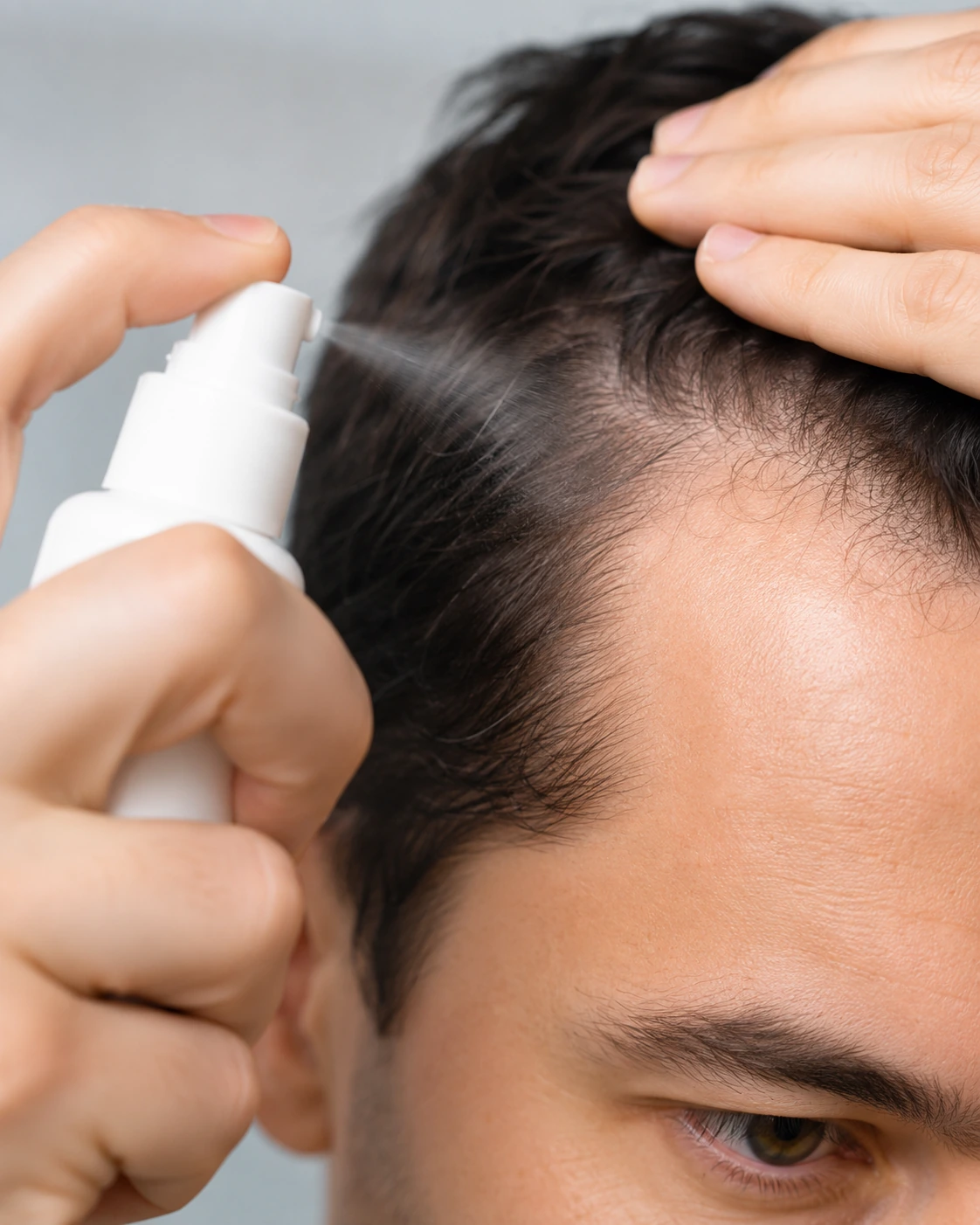
Finasteride is best known as a tablet, but it also comes as a lotion or spray for the scalp. This topical form is designed to act primarily locally, resulting in lower exposure for the rest of the body. Research indicates a similar effect on hair growth as the tablet, with lower systemic exposure. However, absorption into the bloodstream is not zero, and there is less long-term research available.

Topical finasteride at a glance
| Characteristic | Topical finasteride |
|---|---|
| Active ingredient | Finasteride |
| Form | Lotion or spray for the scalp |
| Studied strength | Mainly 0.25%; preparations of 0.1–0.25% |
| Mechanism | Inhibits 5-alpha-reductase and lowers DHT mainly locally |
| Systemic exposure | Lower than with the tablet, but not zero |
| Approval | Not approved in the Netherlands |
| Availability | Compounded preparation on prescription |
| Intended for | Men with hereditary hair loss, after assessment |
| Not suitable for | Women and people under 18; finasteride is teratogenic |
| First result | Usually after three to six months |
| Reimbursement | Not covered by basic health insurance |
What is topical finasteride?
Topical finasteride contains the same active ingredient as the finasteride tablet but is applied directly to the scalp. The most studied concentration is 0.25%. In practice, preparations between 0.1% and 0.25% are also used.
Topical finasteride is not registered as a ready-made medication in the Netherlands. It is only available as a compounded preparation: a pharmacy makes it based on a doctor's prescription.
You can read more about how finasteride works in general in our blog post about finasteride.
How does topical finasteride work?
Hereditary hair loss in men is caused by DHT (dihydrotestosterone). Finasteride inhibits the enzyme 5-alpha-reductase, which converts testosterone into DHT. This reduces DHT production and can slow down the miniaturization of hair follicles.
The tablet works throughout the entire body. Topical finasteride is primarily targeted at the scalp and results in lower exposure in the blood. However, absorption is not zero: the topical form also lowers DHT levels in the blood, though less significantly than the tablet.
Topical versus oral: what does the research say?
In a 2022 phase III study by Piraccini et al., a 0.25% finasteride spray was tested on 458 men with hereditary hair loss.
Hair growth: after 24 weeks, the hair count increased more significantly than with the placebo: an average of +20.2 versus +6.7 hairs. According to the researchers, the effect was comparable to that of the tablet.
DHT in the blood: serum DHT levels decreased by approximately 34.5%, compared to 55.6% with the tablet.
Finasteride in the blood: the peak concentration was more than a hundred times lower with the topical form.
Sexual side effects: these were reported by 1.4% in the topical group and 3.3% in the oral group. The study was not designed to definitively prove this difference.
The main conclusion is that topical finasteride in this study provided similar hair results to the tablet, with lower systemic exposure. However, side effects remain possible.
| Characteristic | Topical finasteride | Oral finasteride |
|---|---|---|
| Administration | Lotion or spray | Tablet, once a day |
| Hair growth | In phase III comparable to the tablet; +20.2 hairs versus +6.7 on placebo | Well supported and considered the reference treatment |
| Reduction in serum DHT | Approximately 34.5% | Approximately 55.6% |
| In the blood | Peak concentration more than 100× lower | Higher systemic exposure |
| Sexual side effects | 1.4% reported; difference not proven | 3.3% reported in the same study |
| Local reactions | Redness, itching or irritation possible | Rare |
| Long-term data | Limited | Extensive |
| Approval in the Netherlands | Not approved; compounded preparation | 1 mg approved for men |
Side effects of topical finasteride
Topical finasteride primarily has a different side effect profile than the tablet. Local skin reactions, such as redness, itching, and irritation, are more common and are usually mild.
Systemic side effects, such as reduced libido or erectile dysfunction, are less likely due to lower absorption, but they cannot be ruled out. Furthermore, finasteride is teratogenic: women who are pregnant or may become pregnant must not come into contact with the medication or a recently treated scalp. Therefore, allow the treated area to dry thoroughly.
| Point of attention | Explanation |
|---|---|
| Local skin reactions | Redness, itching or irritation; usually mild |
| Sexual side effects | Less likely than with the tablet, but not excluded |
| DHT in the blood | Drops less than with the tablet, but not to zero |
| PSA level | May drop; report use when having a PSA test |
| Pregnancy | Teratogenic; avoid contact with pregnant women |
You can find more information in our blog about finasteride side effects.
Combining topical finasteride and minoxidil
Topical finasteride is often combined with minoxidil, usually in a single formulation. Finasteride inhibits DHT, while minoxidil stimulates hair growth. There is evidence that the combination is more effective than either treatment alone.
Read more about this in our blog combining finasteride and minoxidil.
Is topical finasteride available in the Netherlands?
There is no ready-made topical finasteride medication registered in the Netherlands. A pharmacy can only prepare this as a magistral preparation with a doctor's prescription.
At 3CO, we expect to have a topical spray with finasteride (0.25%) and minoxidil (5%) available by the end of 2026. Via this page you can sign up to be notified as soon as the spray is available.
We currently offer oral finasteride and oral minoxidil. Both treatments are available by prescription only following an online consultation.
Frequently asked questions about topical finasteride
What is topical finasteride?
Topical finasteride contains the same active ingredient as the tablet but is applied to the scalp as a lotion or spray. The most studied strength is 0.25%. Systemic exposure is lower than with the tablet, but not zero.
Does topical finasteride work as well as the tablet?
In a phase III study, a finasteride 0.25% spray clearly improved hair growth compared with placebo. According to the researchers the effect was comparable to that of the tablet. However, less long-term research is available for the topical form.
Does topical finasteride have fewer side effects than the tablet?
The lower absorption makes systemic side effects such as reduced libido less likely, but not impossible. Local reactions such as redness, itching and irritation are in fact more common.
Is topical finasteride approved and available in the Netherlands?
No ready-made medicine containing topical finasteride is approved in the Netherlands. A pharmacy can only prepare it as a compounded preparation on a doctor's prescription.
Do you need a prescription for topical finasteride?
Yes. Finasteride is prescription-only in topical form as well. A doctor assesses in advance whether the medication is suitable and safe for you.
Can you combine topical finasteride with minoxidil?
Yes, topical finasteride is often combined with minoxidil, usually in a single preparation. Finasteride inhibits DHT and minoxidil stimulates hair growth. A doctor assesses whether the combination suits you.
Can women come into contact with topical finasteride?
Finasteride is teratogenic. Women who are pregnant or may become pregnant must not come into contact with the product or with a freshly treated scalp. Let the treated area dry thoroughly.
How do you apply topical finasteride?
Apply the product to a dry scalp on the areas with hair loss, usually once a day. Wash your hands afterwards and let the scalp dry. Always follow the instructions of the doctor and the compounding pharmacy.
Sources
- Piraccini BM et al. Efficacy and safety of topical finasteride spray solution for male androgenetic alopecia: a phase III, randomized, controlled clinical trial. Journal of the European Academy of Dermatology and Venereology.2022;36(2):286–294.
- Caserini M et al. Effects of a novel finasteride 0.25% topical solution on scalp and serum dihydrotestosterone in healthy men with androgenetic alopecia. International Journal of Clinical Pharmacology and Therapeutics.
- Summary of Product Characteristics for finasteride 1 mg. Dutch Medicines Evaluation Board (CBG-MEB).
- Pharmacotherapeutic Compass. Finasteride for alopecia.
- NHG Clinical Guideline for Alopecia.